Software Heritage at UN Open Source Week 2026
While open source is often discussed as a broad policy aspiration, the work at UN Open Source Week in New York focused on turning it into a measurable reality.
Over 2,600 people from over 120 countries registered to take part in the global conversation on open source as shared infrastructure. This operational focus anchored the public kick-off of the Public Code Observatory.
The milestone: Launching the Public Code Observatory
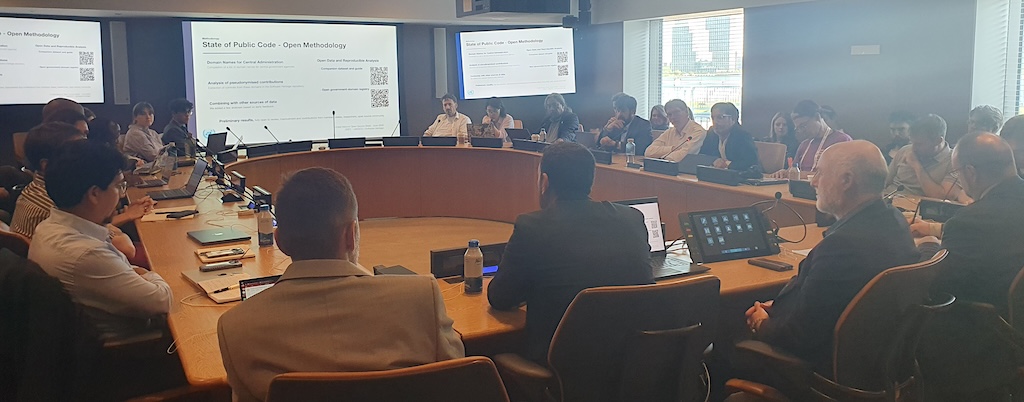
The headline of the week, from our perspective, was the public kick-off of the Public Code Observatory — a collaborative initiative to map public-sector contributions to open source worldwide. Co-led by Software Heritage (Roberto Di Cosmo), UN-ODET (Omar Mohsine, with USG Amandeep Singh Gill), and UNESCO (Guilherme Canela de Souza Godoi), the Observatory brings together institutional weight and technical depth to do something that hasn’t been done before at this scale.
Its first output, The State of Public Code, presented jointly at UN Open Source Week, is the first evidence-based global picture of how governments are contributing to and building on open-source software. The research is conducted directly on the Software Heritage Archive — itself recognized as a Digital Public Good — the world’s largest open collection of publicly available source code. The first edition of the report already spans 199 countries and territories, with a striking headline finding: a country’s public-code contribution correlates twice as strongly with its digital-government maturity as with GDP per capita — public code is a policy choice, not a wealth effect.
The session drew a packed room, and according to Bastien Guerry and Daniel Izquierdo, who co-presented the report, the energy in the room reflected something real. The audience — a mix of analysts, government representatives, nonprofits, and educators — engaged with the findings from every angle: why this kind of data matters, what it means for cross-border collaboration in an increasingly fractured geopolitical landscape, and how open source provides a unique mechanism for governing that collaboration across boundaries.
Izquierdo singles out the cross-border collaboration analysis as the moment that visibly landed: «It opened eyes during the session — open source as the way to bridge those connections without formal/political bilateral agreements.» The consensus in the room, he says, was clear: the value of the initiative is understood, the scale of the Software Heritage archive makes it uniquely credible, and the expectation is already set for a next iteration with richer datasets.
This is only the beginning. The methodology, the data, and the analytical pipeline are open for collaboration. If your institution, government, or research group wants to be part of shaping what comes next, watch this space — and get in touch to be involved in future discussions.
Software Heritage on the ground
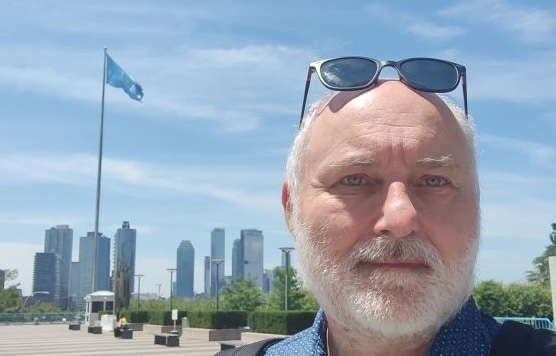
Software Heritage was well represented in New York, with Director Roberto Di Cosmo, Morane Gruenpeter, Bastien Guerry, and Daniel Izquierdo on the ground contributing to global conversations on open science, public code preservation, and shared digital infrastructure.
Beyond the main tracks, the team participated in a series of community-led side events with partners including Sovereign Tech Agency and CURIOSS alongside RISE Research Institutes of Sweden, OpenForum Europe, and Red Hat, hosted by IBM.
Meeting the maintainers
Bastien Guerry joined the Maintainathon — convened for the second year by the Sovereign Tech Agency and UN-ODET — to dig into how to use and contribute to the Software Heritage Archive. The maintainathon brought together the experts building and maintaining critical digital infrastructure, and the archive was squarely on the agenda.
A third of the audience already knew Software Heritage. Several people asked what we archive, leading to a discussion on published code—including non-free software—and plans for repository data like issues and pull requests. When asked about prompts for AI assistants, the consensus was «not yet,» as that responsibility will likely fall to the forge platforms. Finally, we asked the audience how they would expand our data, build new services, or anticipate the impact of AI. Their responses were highly inspiring.
Guerry also joined a panel discussion — «Public Investment for Open Source Infrastructure: The Sovereign Tech Agency Model in a Global Ecosystem» — with Qianqian Ye, Timothy Lehnen, and Lauren Gardner, exploring how to build institutional capacity for collective action around open source software and the digital infrastructure it underpins.
During the discussion, the focus was less on the software itself and more on the infrastructure that supports maintainers. And just as road safety has improved by enhancing both roads and cars, a consensus emerged that improving this infrastructure is essential—perhaps even more so in the age of AI. Securing and maintaining this infrastructure collectively is best achieved through the active involvement of public agencies.
CURIOSS Gathering
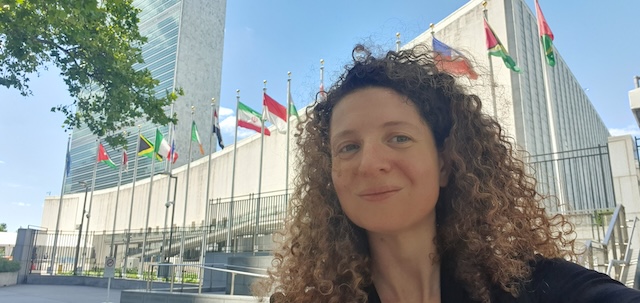
Morane Gruenpeter gave a lightning talk at the CURIOSS event — «Building a Window into the Software Heritage Cathedral» — introducing OSPO-Radar, a Software Heritage project funded by the Alfred P. Sloan Foundation.
Open source software is central to research, but institutions often don’t know what software they produce and use, who maintains it, or how it supports their impact. OSPO-Radar fills this gap by connecting institutions with the Software Heritage archive, helping research institutions, OSPOs, funders, and infrastructure providers document, manage, and share their open source work.
The project is now seeking co-design partners, pilot institutions, advisory members, and open source contributors. To properly recognize and preserve research software, institutions need to work together rather than act alone. You can stay up-to-date on the project by signing up for the mailing list.
UN Open Source Week 2026 made one thing clear: the question is no longer whether open source matters to governments and institutions. It’s whether the infrastructure exists to measure, preserve, and build on it responsibly. Software Heritage’s answer — the archive, the identifiers, the mirrors, the analytics — is already there. The work now is scaling it.