
The world’s first government open source insights report launches at UN Open Source Week

For the first time, there is evidence on how the world’s governments engage with open-source software — not as a policy aspiration, but as a measurable reality. Who contributes, how much, from where, and what it tells us about digital readiness at a national level.
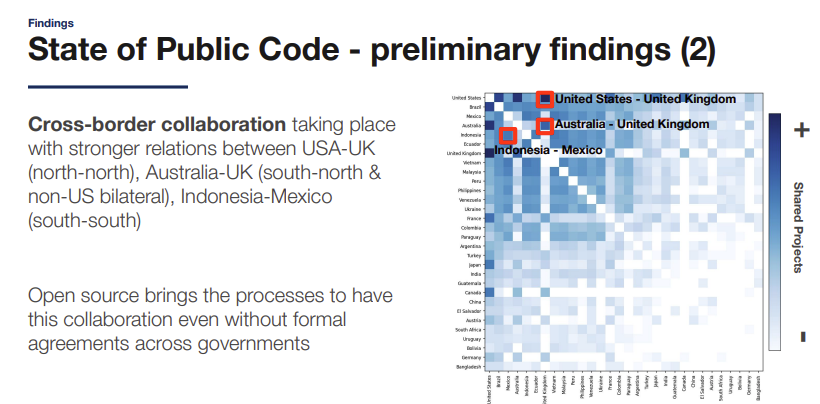
At the recent UN Open Source Week in New York, Software Heritage, UNESCO, and the United Nations Office for Digital and Emerging Technologies (ODET) presented “The State of Public Code” report. This is the first evidence-based, global picture of how governments around the world are using, contributing to, and building on open-source software.
The report doesn’t just describe a landscape. It measures it — with real figures drawn from source code itself. You can download the full 24-page report here or learn more about the analysis and process.
One of the initial findings: A country’s standing in global open source isn’t bought; it’s built. The data backs this up with some precision: how much a nation contributes to public code correlates more than twice as strongly with broader digital readiness (ρ = 0.52) than it does with raw GDP per capita (ρ = 0.26), and because that statistic scales quadratically, the real gap in explanatory power is closer to fourfold.
Correlation isn’t causation, but the implication is hard to ignore: participation in the global commons of source code isn’t gated by wealth. It’s gated by institutions, skills, and infrastructure, all of which a country can choose to build.
Built on the world’s largest software archive
The research underpinning the report is conducted directly on the Software Heritage Archive — recognized as a Digital Public Good — the world’s largest open collection of publicly available source code, preserving nearly 29 billion unique files from more than 438 million software projects. This makes the findings uniquely grounded: not in surveys or self-reporting, but in the code governments have actually written, shared, and published.

“Code publications from the French public sector played a major role in the creation of an Open Source Program Office in 2021,” says Bastien Guerry, current Head of Partnerships, Public Sector & Industry at Software Heritage, and former French Chief Free Software Officer. “Today, government agencies want to know where their code ends up—not just out of curiosity, but also to think strategically about their commitment to open source. With a global view, governments could also identify new opportunities to work together.”
New partnerships
The report also marks the beginning of a significant collaboration. Daniel Izquierdo and Luis Cañas-Díaz, longtime figures in the open-source metrics world at Bitergia — a company with over 15 years of experience measuring open-source community activity, contribution patterns, and ecosystem health — are joining the effort to co-develop the methodology and tooling behind the Insights Report. Their work will help evolve Software Heritage’s current analytical pipeline by integrating their tools, bringing a new level of rigor and depth to how the archive’s data is interpreted and presented.
“After more than 15 years of analyzing OSS ecosystems, I’m delighted by the challenge of joining forces with the biggest archive of OSS projects in the world to help them improve the Insights Report,” Cañas-Díaz notes.

Your code belongs in the archive
The Software Heritage Archive is only as complete as what’s been preserved — and if your organization’s code isn’t in it, now is the time.
Whether you’re a government agency, a public institution, an open source project, or an individual developer, contributing to the Archive means your work becomes part of the permanent, open record of human software knowledge.
Preserve your work today with the Save Code Now feature or become a Deposit Partner or a Deposit Interest Group Member by reaching out to dig@softwareheritage.org.