
The invisible code running the world (and who pays for it)
The digital world is currently facing a structural debt. For years, the global economy has treated open-source software as a free, inexhaustible resource. But the Software Heritage 10th Anniversary Symposium at UNESCO, leaders from the EU, France, Germany, and the philanthropic sector issued a warning: the “invisible layer” of our society is cracking, and the volunteers holding it together are exhausted.
The human cost of infrastructure
Bastien Guerry, the panel’s moderator and Head of Partnerships at Software Heritage, opened the session not with statistics, but with a warning of systemic failure. Guerry described his own exit from software maintenance a decade ago, citing a “maintainer fatigue” that made the burden of helping others without support impossible to bear. Today, that fatigue has scaled. What was once a personal burnout is now a threat to the stability of the French state and global foundations. You can catch the entire 49-minute session on YouTube.
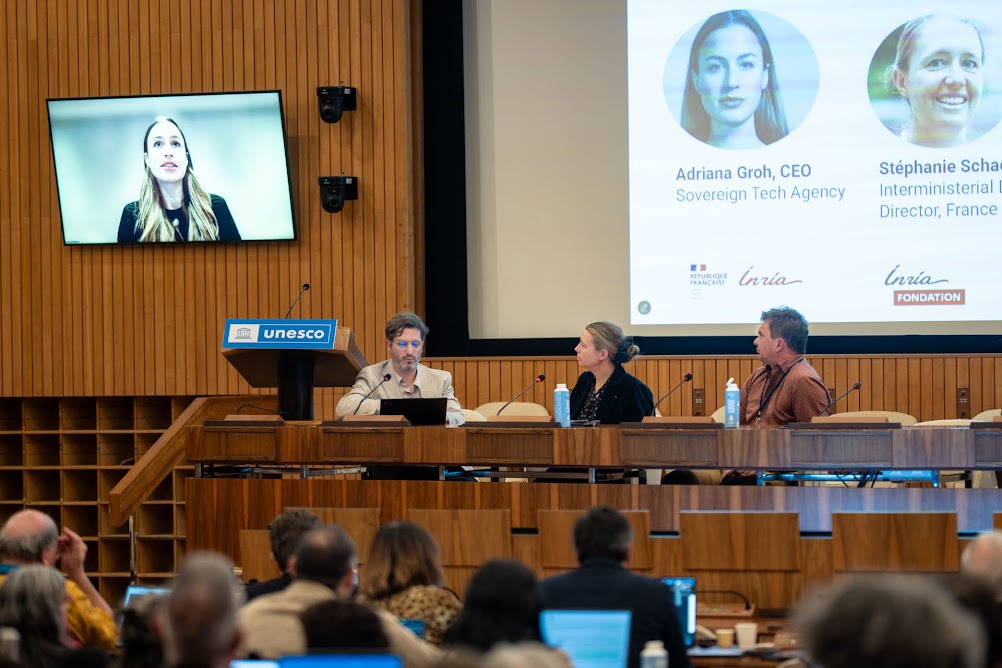
© Inria / Photo B. Fourrier. Not pictured: Thibaut Kleiner via video
Digital sovereignty as a “tech offer”
France and Germany are moving beyond the “altruism” of the early open-source movement, reframing it as a matter of national autonomy. Stéphanie Schaer, The Interministerial Directorate for Digital Affairs in France (DINUM), highlighted Tchap—a secure messaging app used by 400,000 civil servants—as proof that the state can break its dependency on “monopolistic IT solutions” by investing in the digital commons. Beyond messaging, Schaer pointed to a sovereign video conferencing solution launched just one year ago. Built on open-source foundations of LiveKit, the tool already serves 40,000 users and is designed for interoperability with German colleagues. With a roadmap to scale to one million civil servants, Schaer noted that this isn’t just a pilot—it’s a strategy in action.
“For us, open source is critical because it is a direct vehicle for autonomy,” Schaer explained. By investing in these digital commons, the state is actively breaking its dependency on monopolistic IT solutions and proving that a sovereign “tech offer” can deliver results at a national scale.
Similarly, Adriana Groh, managing director of the Sovereign Tech Agency, (STA), argued that we must view code with the same seriousness as physical civil engineering. “In the 21st century, the infrastructure we as a society rely on isn’t just made out of concrete,” Groh said, emphasizing that public interest now demands the maintenance of this “invisible layer.”
The $10 billion investment gap
Dario Taraborelli of the Chan Zuckerberg Initiative (CZI) offered a blunt blueprint for stabilizing open science: stop treating software as a research “afterthought.”
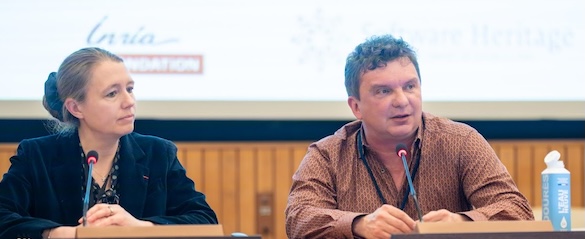
© Inria / Photo B. Fourrier
While modern science is entirely dependent on open-source foundations, these tools are often starved for cash because funders traditionally prioritize “novelty” over maintenance. Taraborelli pointed out that a mere $10 billion annually—a fraction of global R&D spending—would bridge this gap, allowing these digital communities to thrive rather than just survive.
To solve the chronic bottlenecks of volunteer-led code, CZI has already invested $15 million into the human maintainers behind “household” libraries like Python, R, and Julia. Their strategy centers on a multi-funder model—partnering with giants like the Wellcome Trust—to prove that digital sovereignty is only as strong as the “invisible” labor beneath it.
A global third way
The European Commission is now attempting to organize its historically scattered investments. Thibaut Kleiner noted that while the EU has funneled €800 million into the space, the lack of curation meant much of that code was never properly maintained. The new strategy is to treat open source as a “global agenda,” providing a “tech offer” that allows countries to build their own local ecosystems rather than buying “black boxes” from the US or China.
The message of the panel was clear: the era of free-riding is over. To secure the digital future, we must begin treating the people who write the world’s code as the essential public servants they are.
At the event, the STA and Software Heritage announced a collaboration to ensure that critical open-source projects supported by the Sovereign Tech Fund are systematically archived, establishing permanent preservation as a standard for these projects.
“Open source maintainers build the foundations of our digital world, often without institutional support or long-term preservation guarantees,” said Groh from the STA. “By partnering with Software Heritage, we ensure that the projects we invest in remain accessible, traceable, and preserved for the long term—protecting both the code and the story of its development,” Groh added.
Catch all the sessions from the Symposium on YouTube.
#SWH10